
DOT Goes Google, NJ Draws AV Battle Lines
DOT Tech News
July 20, 2026 · Transportation Technology Briefing
Good morning, DOT tech nerds and professionals. This week the Department of Transportation made a big move by becoming the first cabinet agency to shift 60,000 employees to Google Workspace. We also have a look at a New Jersey autonomous vehicle bill that could reshape who gets to play in the AV space before the first car even hits the road.
In this week's DOT Tech News:
- DOT Becomes First Cabinet Agency to Move 60,000 Employees to Google Workspace
- New Jersey's AV Pilot Bill Would Lock Tesla Out Before It Even Starts
DOT Becomes First Cabinet Agency to Move 60,000 Employees to Google Workspace
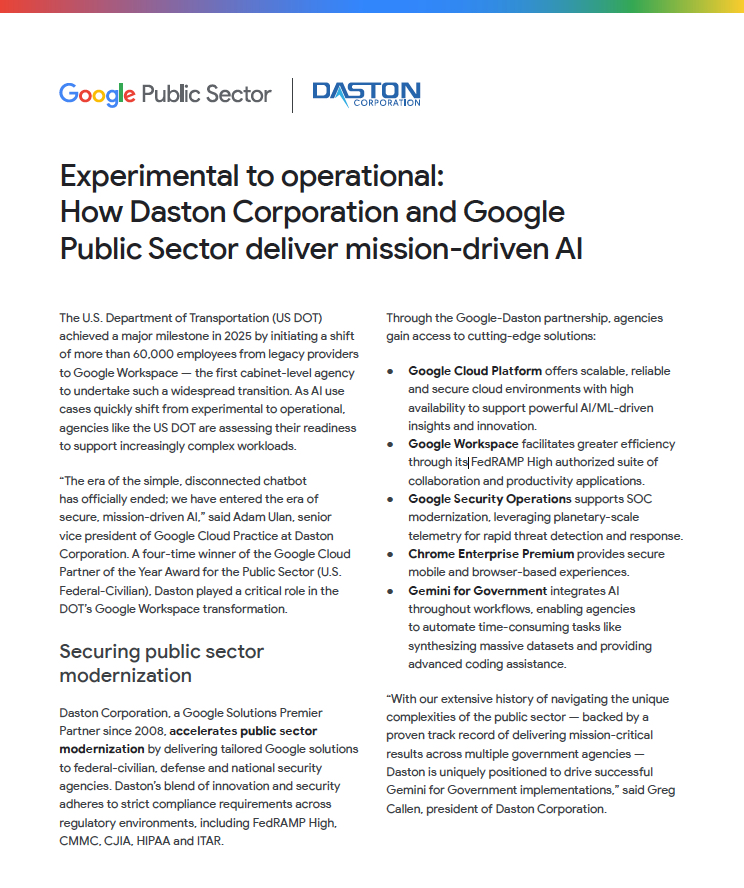
The U.S. Department of Transportation hit a landmark in 2025, migrating more than 60,000 employees to Google Workspace — making it the first cabinet-level agency to execute a productivity platform shift at this scale.
DOT partnered with Daston Corporation and Google Public Sector to drive the transition. The move signals more than a software swap — it marks DOT's push to build the infrastructure needed to run AI workloads operationally, not just as pilot projects gathering dust in sandbox environments.
Federal agencies have spent years experimenting with AI tools. DOT's Google Workspace migration positions the department to actually deploy those tools at scale, with Daston serving as the systems integrator bridging Google's commercial cloud capabilities and federal compliance requirements. That combination matters when you're handling sensitive transportation data across modal administrations like FHWA, FAA, and FTA.
The Daston-Google partnership published an impact brief outlining the DOT transformation and pitching similar solutions to other agencies. The brief is gated behind a registration form, so treat it as a vendor marketing document — but the underlying migration milestone is real and significant.
Why it matters: Any software vendor targeting DOT agencies should take note — DOT leadership just bet big on Google's ecosystem, and integration partners who build on or connect to Google Workspace now have a clearer path into a 60,000-seat federal customer.
Source: Department of Transportation
New Jersey's AV Pilot Bill Would Lock Tesla Out Before It Even Starts

New Jersey legislation would require autonomous vehicle testers to use sensor technology that Tesla's current hardware cannot meet, effectively barring the company from any future state pilot program.
Twin bills SB1677 and AB3968 are sitting in Senate and Assembly committees. They would create a three-year AV pilot program allowing testers to operate on public roads and designated testbeds. The critical barrier for Tesla: the bills mandate cameras plus two distinct sensing modalities capable of detecting obstacles if the camera system fails. Tesla runs cameras only — no lidar, no radar.
Before any vehicle goes fully driverless, testers must log at least 50,000 miles on public roads with a safety driver present and carry a minimum $5 million liability bond. Crash reporting requirements are tight — five calendar days for serious incidents, ten for all others.
The bills land as NHTSA Administrator Jonathan Morrison issued a formal call to action demanding AV developers immediately fix what the agency calls a "clear pattern" of driverless vehicles blocking ambulances, driving into active emergency scenes, and failing to respond to flares, cones, and flashing lights. Morrison called the inability to recognize emergency scenes "a functional insufficiency," not an edge case.
Why it matters: State AV pilot programs increasingly shape the technical baseline for autonomous deployment, and DOT agencies evaluating AV partnerships need to track how sensor requirements and safety mandates vary jurisdiction by jurisdiction.
Source: Department of Transportation
Sponsored by Sourcetoad: Custom software and AI solutions for the AEC Industry.
Add a comment: