
AI Trust Gaps and $17M in Road Safety Grants
DOT Tech News
March 9, 2026 · Transportation Technology Briefing
Good morning, DOT tech nerds and professionals. This week we're looking at two sides of the same coin: money flowing in to accelerate transportation data modernization, and the human factors that determine whether any of it actually sticks. Both stories have real implications for how your agency or your clients approach AI right now.
In this week's DOT Tech News:
- Connecticut's $17M AI Road Safety Grants Show How Universities Can Accelerate DOT Data Modernization
- DOT's AI Lead Says Employee Trust, Not Technology, Is the Real Barrier to Scaling AI
Connecticut's $17M AI Road Safety Grants Show How Universities Can Accelerate DOT Data Modernization

The Connecticut Transportation Institute landed three federal grants totaling over $17 million to deploy AI-powered intersection monitoring, overhaul crash reporting forms, and explore automated speed enforcement on the UConn campus.
The largest grant — $10.4 million from FHWA and CT DOT — funds AI cameras at campus intersections that track how close vehicles and pedestrians come to each other. Principal investigator Kai Wang has already tested the system at three UConn intersections. The overhead cameras capture movement paths, not faces, sidestepping privacy concerns that often stall similar deployments.
A $6.7 million NHTSA grant tackles a persistent data gap: crash reports don't reliably capture incidents involving e-bikes or autonomous vehicles. The current system depends on officers voluntarily mentioning "e-bike" in a narrative field. The grant will fund a redesigned crash reporting form that makes these fields explicit — critical as e-bike fatalities rise and states scramble to count them accurately.
The third grant, $1.5 million through the Safe Streets and Roads for All program, funds feasibility analysis for red-light and speed cameras at UConn, using West Hartford's existing speed camera program as a benchmark.
Why it matters: DOT agencies and their vendors should watch this model closely — university research centers are becoming fast-moving testbeds for AI safety tools and crash data infrastructure that state DOTs will eventually need to procure and scale statewide.
Source: Department of Transportation
DOT's AI Lead Says Employee Trust, Not Technology, Is the Real Barrier to Scaling AI
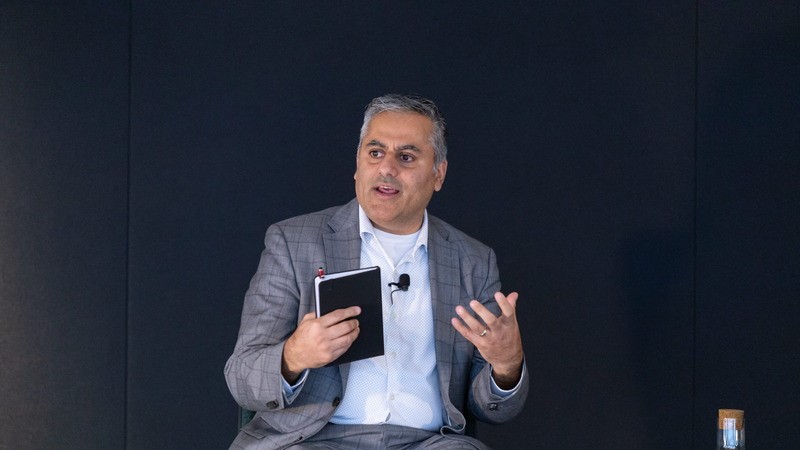
DOT senior AI advisor Anil "Neil" Chaudhry told a ServiceNow Government Forum audience that scaling artificial intelligence across the federal government depends less on the tools themselves and more on whether employees trust the outputs.
Chaudhry described a "double-blind approach" where human-generated and AI-generated work are reviewed side-by-side without reviewers knowing which is which. Once staff can no longer tell the difference, the agency scales that use case up. If they can't reach that bar, they don't. He warned that distrust creates a hidden cost: staff simply redo the AI's work, collapsing any efficiency gains and breaking governance.
DOT is currently applying AI in two priority mission areas: integrating autonomous vehicles into national infrastructure and optimizing supply chain efficiency. Chaudhry framed both as urgent, not exploratory. "We need to be delivering now, not two years from now," he said. ServiceNow's Miguel Donayre reinforced that agencies should define the problem before reaching for an AI solution.
Chaudhry's framework for adoption centers on incremental wins — small daily improvements that compound across large workforces. His math: if 100 employees each get 1% more productive, the organization moves.
Why it matters: DOT agencies and their vendors should treat employee trust as a technical requirement, not a soft concern — because untrusted AI outputs don't save time, they just create duplicate work.
Source: Department of Transportation
Sponsored by Sourcetoad: Custom software and AI solutions for the AEC Industry.
Add a comment: